Uganda Trip #15 | Post 7
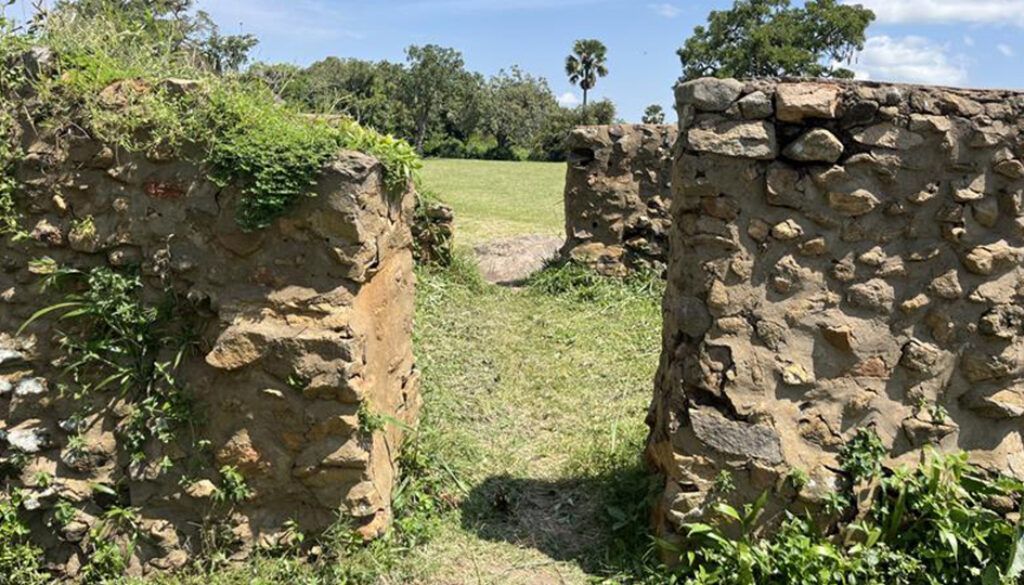
The picture that accompanies this post is called, “The Gate of No Return.” I’ll get back to that shortly.
Mike, Stu and I had another day trip today. Classes are all over. Students are taking their finals and tomorrow is graduation. We made our way to Fort Patiko. Here is the story related to this infamous place, as told to us by our guide, Ronald.
From 1850-1853 this location served as a market between local Acholi people and Arabic-Sudanese. Due to language barriers, their goods we simply laid out and silently bartered. The Acholi had coveted ivory tusks, and the others brought earrings, bracelets, textiles and other prestige goods. As the ivory supply dwindled, the Acholi lost their bartering capacities.
At the end of the three years, those who entered the gate that was formerly a market, now entered a place that transitioned from a trading post of goods to humans. For three years, people walked in and out of this market door with no problems. After the ivory was gone a hideous change took place and the gate that lead to a trading post became the Gate of no Return.
Once you walked inside the gate, the area that used to be the market (about the same area of a football field) was passed through and they were put into jail. These jails were basically clefts in a rock formation that was guarded by the only way out.
Eventually they were taken out of jail and evaluated. The healthy went in one direction where they were held until they began a 74-kilometer walk, to Nimule, Sudan’s border town. They would then continue their transport further into Khartoum, Sudan, it’s capital city.
Those who weren’t healthy, or ugly (these are the words of our guide), physically handicapped, old, or for some other reason did not get chosen for Sudan were beheaded. Ronald pointed out marks on the rock formations we stood on from the machetes after they went through the neck. They would then roll the bodies and heads off the edge of the rocks where hyenas would come at night and eat them. So hard to fathom!!!
Sir Samuel Baker, a British leader visited Khartoum in 1862 and saw slavery was the industry that kept the city bustling. Later in the decade Baker was commissioned to lead a military expedition with one of the goals being to eradicate the slave trade that was taking place. He took 1700 Egyptian troops with him and took over the area, stopped slave trading in that area and Fort Patiko was renamed Baker’s Fort. Our tour was over.
It is hard to be confronted with the ugliness with which we treat each other. When human beings become commodities-something significant, something sacred is lost. We dehumanize others in smaller ways with regularity.
Recognizing all people of all sizes and shapes, rich and poor, progressives and conservatives, those who think like us and those who don’t, are image bearers who are to be afforded the dignity of those who have been “made a little lower than the angels.”
Some of the very men who graduate tomorrow have relatives who have been mistreated by others in hideous ways (see blog #6). God can do abundantly more than what we could ask or think.
Tomorrow is graduation day!
Larry Szyman
Pastoral Associate